
MEDIA:
La Vanguardia
DATE:
21.02.2026
TITLE:
“Diálogo artístico entre la monja fotógrafa Isaura Marcos y el escultor Guido Dettoni della Grazia“
By:
Toni Ayala (text)
Isaura Marcos (photo)
Translation:
A little over a year ago, photographer and nun Isaura Marcos had to leave the monastery of Pedralbes, where there are no longer any Poor Clares, to begin a new stage in her life at the convent of the Fraternitat de Santa Clara in Vilobí d’Onyar.
On her journey from Barcelona to Girona, the religious photographer has undergone a transformation in her style, characterized by the technique of natural reflections without the use of filters or editing programs, towards a more abstract vision of photography. It is in this new field that she has once again come together with Italian artist Guido Dettoni della Grazia, whom she welcomed to Pedralbes nine years ago.
“We met in person at the monastery, and in 2017 he was kind enough to give me a video he made with my photos,” explains Isaura Marcos. The artist’s intention with that work was “to open the doors of the church of Santa María de Pedralbes further by bringing what is outside inside,” he said.
Guido Dettoni della Grazia explained that Sister Isaura’s “cloister” is “among the cloisters, skies, and trees of the monastery” and her images “reveal to us what is in her environment, as if they were reflections and fragments of her mystical vision, often revealing another way of approaching the reality we perceive.”
So much so that the sculptor admitted to being “fascinated” by Isaura Marcos’ photographs, surprised, moreover, to learn that “all of them had been taken with a simple camera.”
So much so that the sculptor admitted to being “fascinated” by Isaura Marcos’ photographs, surprised, moreover, to learn that “all of them had been taken with a simple compact camera without undergoing any subsequent computer editing.” “They were the result of reflections on surfaces, such as water or glass, and were often the result of the distance between the camera and the subject being photographed, as if the mind were going to penetrate it in order to ingest and metabolize it,” he said.
All of Isaura Marcos’ photographs had been taken with a simple compact camera without any subsequent editing.
Guido Dettoni della Grazia
Italian visual artist and sculptor of sacred works
If at that time the Italian artist wanted to delve deeper into the art of the nun photographer through that video, which we can see reproduced in this article, now it is the nun who has wanted to reinterpret photographically one of the Milanese artist’s most praised works: his artistic version of the Virgin Mary.
Thus, almost a decade later, it is now Isaura Marcos who has sought to explore (and reinterpret) the work of Guido Dettoni della Grazia, a visual artist and sculptor of sacred works who is very popular among pilgrims and private collectors, and best known for two series of sculptures: TAU and MARÍA.
The representation of TAU
At the end of 2004, Guido Dettoni della Grazia felt the need to “give body to the sign of TAU, freeing it from its aesthetic condition as a letter of the alphabet to discover in it the corporeality of Christ in a moment of elevation, almost of flight.”
Thaw is the last letter of the Hebrew alphabet; Tau (T) is also the nineteenth letter of the Greek alphabet. The TAU is a symbol of salvation. In Ezekiel’s vision (Ezekiel 9:4), it is the sign marked on the foreheads of those who will be saved. During his secular life, St. Francis was linked to the religious community of St. Anthony the Abbot. The TAU cross became the symbol of St. Anthony, but its symbolism took on an even deeper meaning for St. Francis because of its symbolic and spiritual significance.
The artist explains that, in his studio in Assisi, he discovered his TAU “by modeling wax in his hands, oscillating between sight and blindness to let the body emerge in reality.” He then reproduced it in wood at its original height of 17 cm and, in 2005, enlarged it to two meters, sculpting it in linden wood to exhibit it on April 30 of that same year in the Upper Basilica of St. Francis of Assisi.
Isaura Marcos, who also exhibited her work in Assisi in 2024, has explored the TAU symbol photographically on several occasions, such as in 2021, when she combined the TAU cross and the violet color of the poppy in a single image to symbolize the history of the relationship between the Church and the monarchy at the Monastery of Pedralbes.
The representation of the Virgin Mary
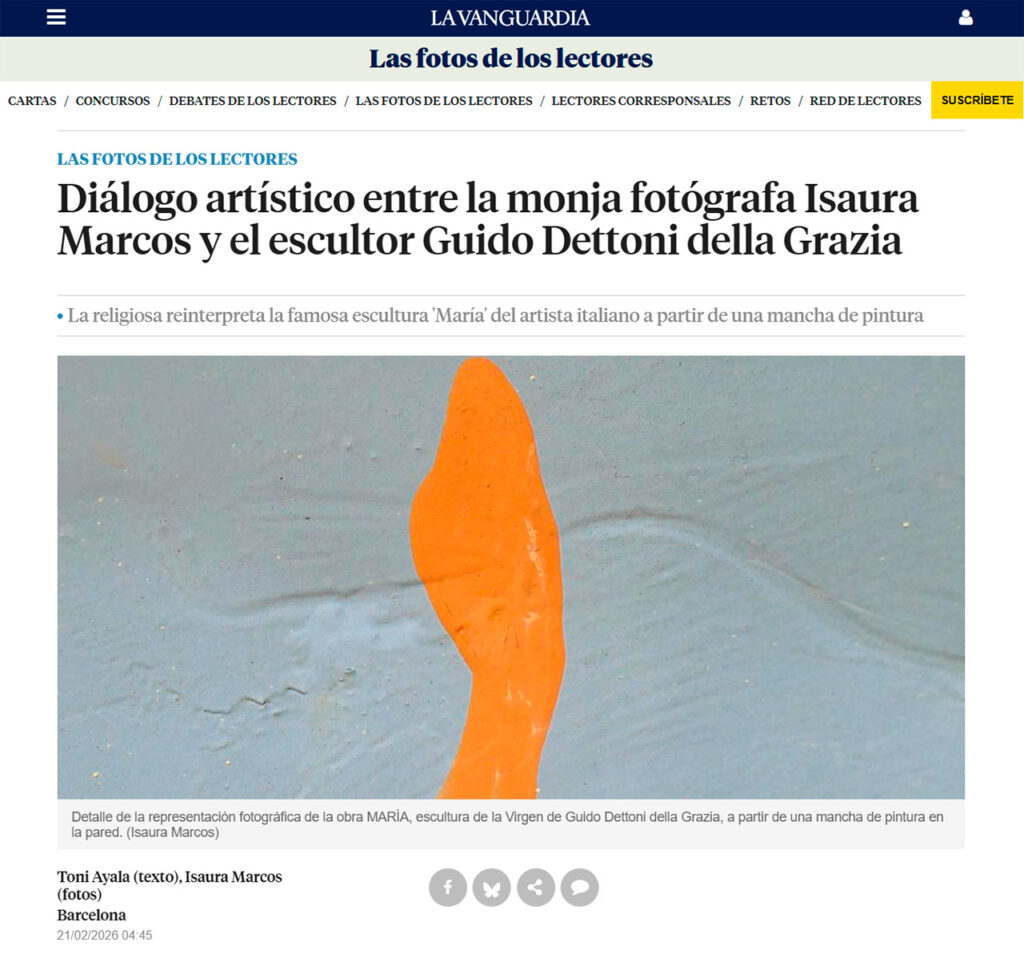
Since her new artistic evolution, more towards abstraction, at the convent of Vilobí d’Onyar, the nun and photographer Isaura Marcos has now, almost a decade after meeting Guido Dettoni della Grazia in Pedralbes, sought to reinterpret MARIA, a famous statue modeled by the Italian artist. The original sculpture is made to measure for the hands, but it is reproduced in different materials, either reduced or enlarged in size, in unlimited copies or in special editions.
MARÍA is a multifaceted icon representing Mary, the mother of Jesus in the Gospel, but also evoking Maryam from Sura 19 of the Koran, Shakti from Hinduism, Kuan-yin from Chinese tradition, and the image of femininity in many cultures around the world.
MARÍA is a multifaceted icon representing the mother of Jesus, but also evoking Maryam from the Quran, Shakti from Hinduism, Kuan-yin from Chinese tradition, and the image of femininity.
Since 1998, the MARÍA sculpture has been installed in cathedrals, churches, universities, and art centers throughout Europe and Asia. Guido Dettoni has been present in Assisi since 2000 with his exhibition MARIA. Isaura Marcos has also shown her photographic work in this Italian town, which she has also captured in books.
En la obra de Isaura Marcos es también recurrente su alusión a la feminidad. No en vano el monasterio de Pedralbes está ligado a las mujeres desde sus inicios. Esta idea subyace también en su tratamiento fotográfico abstracto de la MARÍA de Guido Dettoni della Grazia.
Y una vez más, la monja ha optado por la simplicidad para cerar su obra fotográfica. Y una vez más, también, ha recurrido a la observación de su entorno y su cotidianidad para dar pie a su creatividad artística. “Una mancha de pintura me ha recordado a las esculturas de la virgen del artista Guido Dettoni della Grazia”, explica Isaura Marcos.
Indeed, this is how Isaura Marcos has interpreted MARÍA. If almost ten years ago the Italian sculptor was “fascinated” and “surprised” by the photographs of the nun, what will he think now about this dialogue between his work and that of the Poor Clare nun?
MORE INFO:
https://maria.guidodettoni.com/
https://santamariadellerose.art/